
My first encounter with Alison Croney Moses at the 2018 American Craft Council conference in Philadelphia was both fleeting and anonymous. I saw a mom balancing a baby in a carrier amid the talks and demonstrations. Good on her for coming along, I thought to myself, and I told her so in passing, knowing how much work it must have taken to balance the personal and professional that day. A year later, in my new city of Boston, an artist I’d been connected with over email opened the door to welcome me to a studio visit, and we recognized each other from that conference and were finally formally introduced. We haven’t stopped our conversations since. I admire Alison’s authentic and intentional commitment to youth teaching and community engagement, and have watched her artistic career bloom, most recently with an exhibition at the Institute of Contemporary Art (ICA) Boston as one of the James and Audrey Foster Prize finalists.
Michelle Millar Fisher: For those who don’t know you or your work, how do you usually introduce yourself and what you do?
Alison Croney Moses: I’m an artist working and living in Boston. I’m trained as a furniture maker, but I make sculptures primarily in wood.
MMF
How did you come to work with wood as your primary artistic material?
ACM
I started at the Rhode Island School of Design (RISD) in 2001 in graphic design, but I was actually really bad at it and didn’t enjoy it, and so I switched to furniture making. I was drawn to the furniture program because I saw my friends enjoying themselves, and I had memories of my father making very simple, functional furniture pieces out of pine painted white, like a desk for my sister, a stepstool, and some other things around the house. In that program, I learned about bent lamination, and that’s where it started to click. I loved the process and the outcome. I found a three-dimensional visual language. I had tried and failed to find that in graphic design, but I found it in wood. So now I have this craft foundation that I’ve applied to sculpture.
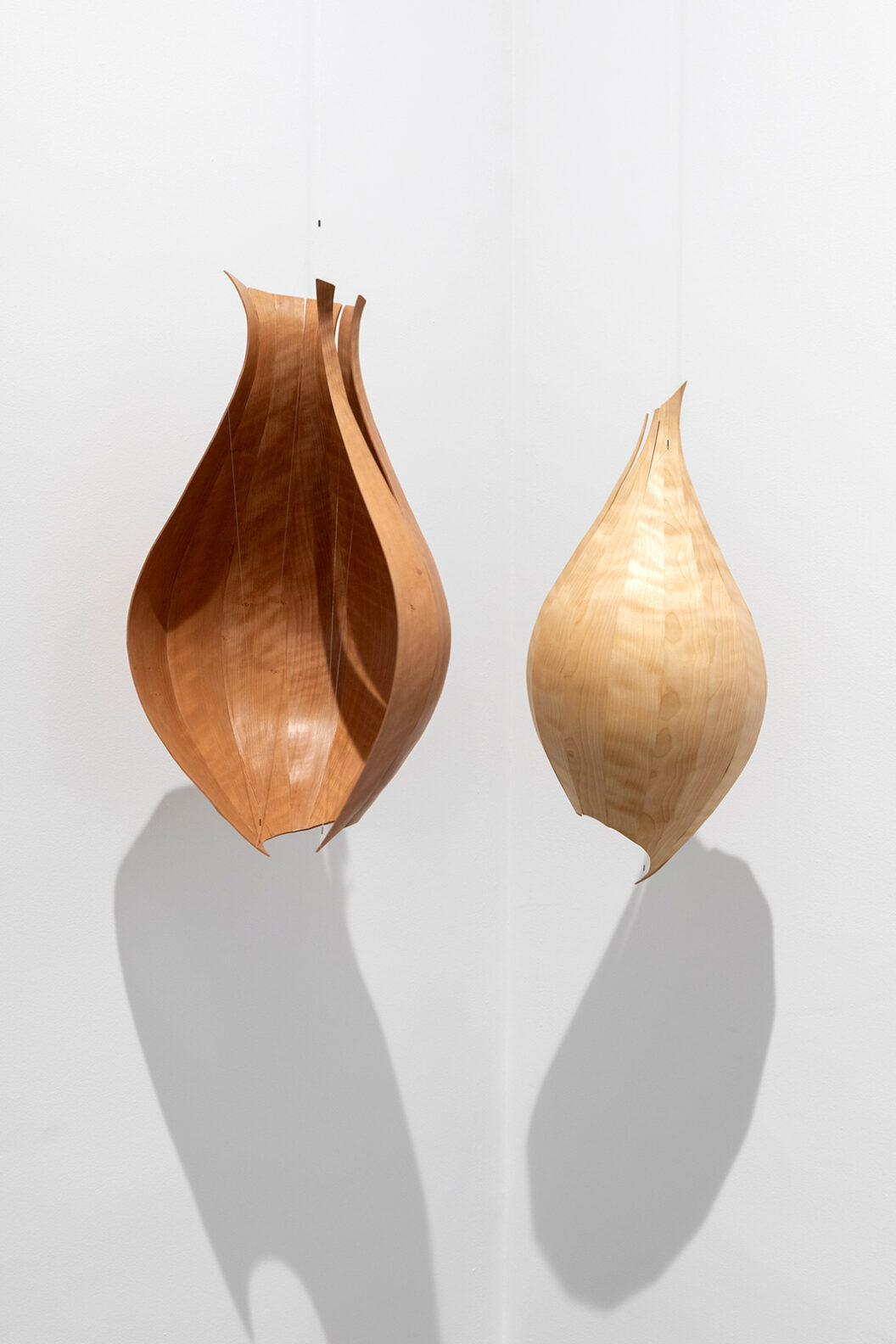
Installation view of (left to right) Alison Croney Moses, Maple Cupped, 2024, maple veneer, 34 × 16 × 12.25 inches; Cherry Twisted, cherry veneer, 36 × 17 × 14 inches. 2025 James and Audrey Foster Prize, Institute of Contemporary Art, Boston, 2025–26. Photo by Mel Taing. Courtesy of the artist.
MMF
I just was looking at a book by the Maine-based carpenter Dale McCormack who writes about “not fighting the work” and tells people to “reposition yourself and try again.” I remind myself of this when I get frustrated.
ACM
Exactly. I had no concrete thoughts on how I would apply my degree in the real world. I was a very independent young person. My dad had died, and my mom was not involved in my college choices, which gave me a certain freedom to make that switch and not even think about the future.
MMF
Your work has dealt with themes of how bodies, yours or others, intersect with really large and important topics like race and motherhood. What have been the subjects and catalysts for your work over the last year or so?
ACM
The work I have brought together in my current exhibition for the Foster Prize at the ICA Boston has a loose theme of being in relation by exploring relationships and connections, perceived and real. I have experimented with suspended, shell-like vessels positioned in conversation with each other. This series, Finding Our Lineage (2025), is the start of an exploration for me about lineage, inheritance, and legacy. This exploration and learning are what I will leave for my children. Many of my vessel forms close at the bottom to hold things, but these reach to the ceiling or the heavens.
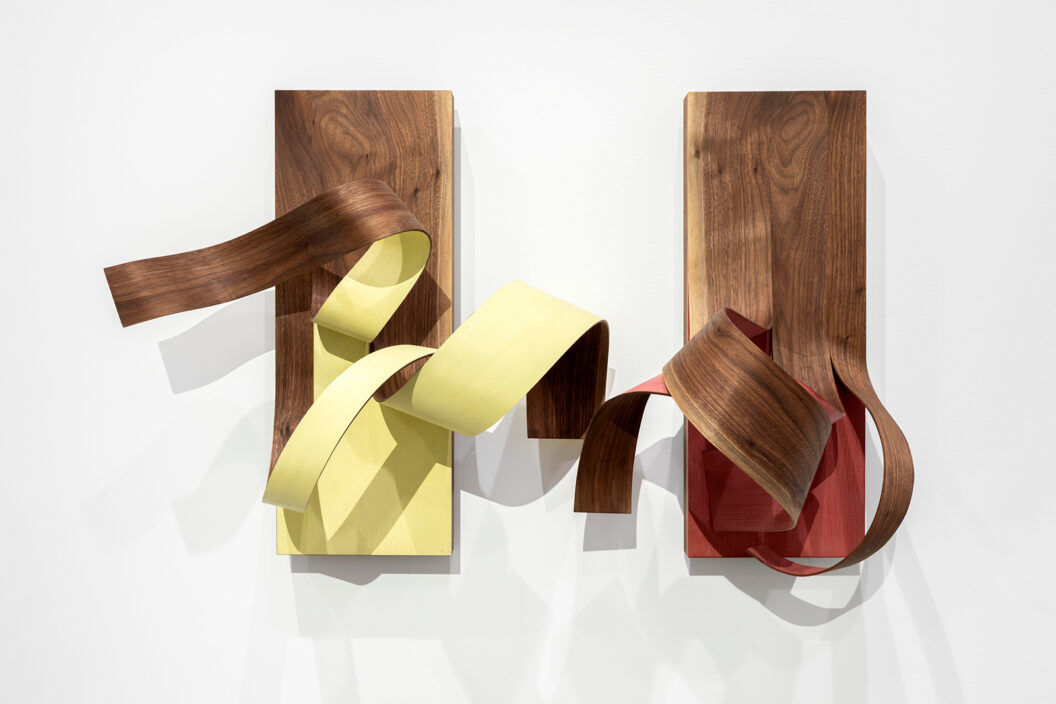
Installation view of (left to right) Alison Croney Moses, Wild in One Way, 2025, walnut wood, milk paint, 23.5 ×24 × 12 inches; Wild in Another Way, 2025, walnut wood, milk paint, 15.5 × 15 × 25 inches. 2025 James and Audrey Foster Prize, Institute of Contemporary Art, Boston, 2025–26. Photo by Mel Taing. Courtesy of the artist.
MMF
I think you’re somebody who’s always learning by doing and growing by learning.
ACM
In my work, I always feel like I didn’t quite get where I wanted to go, but I have to keep striving; that is part of the learning. I have ambitions that are far beyond whatever the next show is, but I also have to give myself a little bit of space and time because I’ve only been doing full-time art practice now for just over a year and a half. I have the goal of learning something new each year. This year I completed a print residency with Caira Art Editions, and we are preparing for the release of my first edition. I am so proud of learning a new medium.
MMF
What are the opportunities you wish you had for your work that you haven’t had yet?
ACM
I have had a vision that I really want to come to fruition of a living memorial to Black women lost through childbirth framed through the voices of the folks still alive in the wake of that experience: a partner, a child, a parent. I want the joyous tellings of these folks’ lives to be documented and to bring their voices into the dialogue around Black maternal healthcare and reproductive rights—all the things that are being ignored today and in the past. There’s priority given to bringing babies into the world right now, but with significant disregard to those who give birth. No universal healthcare, no culturally informed social support. It’s a way to join the hands, head, and heart of my practice.
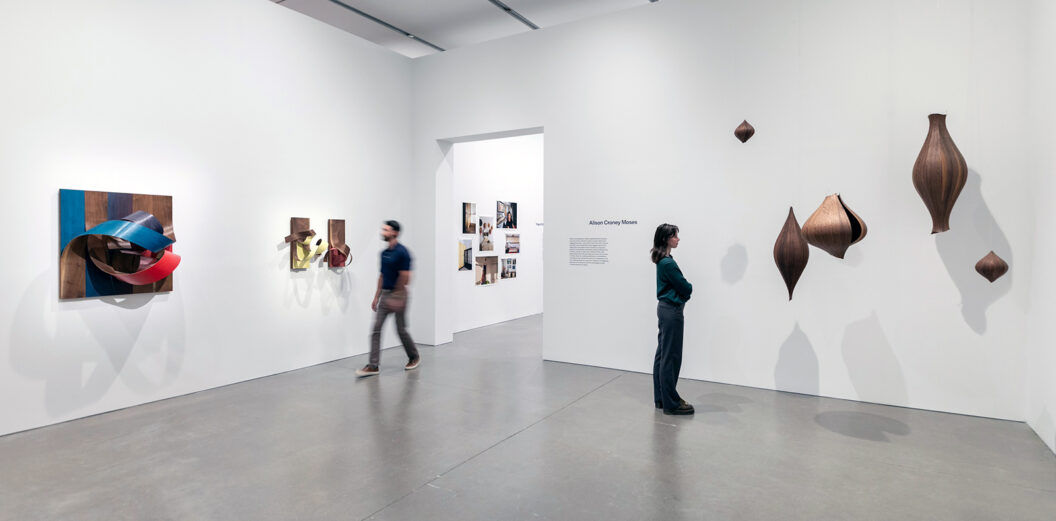
Installation view of Alison Croney Moses, 2025 James and Audrey Foster Prize, Institute of Contemporary Art, Boston, 2025–26. Photo by Mel Taing. Courtesy of the artist.
MMF
Teaching has always been an important part of your work by choice and also by necessity. You know I’m always interested in educational lineages. Who are the teachers who brought you to your own practice?
ACM
It’s a really good question. I have people at every stage. When I was really young at Summit Elementary School, my art teacher, Mrs. Ritter, created an art classroom that was an amazing space of safety when I lost my father. We talked about life in her art room, or we didn’t talk at all. Don Miller, who I am in contact with, taught me bent lamination at RISD. I took a class with Clifton Monteith, a willow-twig furniture maker, at Peter’s Valley, and he encouraged me to travel and became a mentor of mine. I went on a seven-month trip around the world to Japan, India, New Zealand, and Australia, and he was the spark. The last person I’ll mention is Seth Goldberg, who took RISD’s student volunteer program and made it into Catalyst Arts, which provided school credit for community-engaged work. For my senior thesis project, this allowed me to work with youth and build furniture for elementary schools while getting credit. The “clients” were five-year-olds. Working with Seth validated incorporating youth work into my life, which became so important when I took on my role at the Eliot School for Fine and Applied Arts in Jamaica Plain, Boston, where I directed youth programs for a decade.
Now that I’m reflecting on my mentors and my own teaching path, I want to recognize that none that I mentioned are folks of color. I want to change that through my own work. I want people pursuing craft to see themselves more fully reflected in their learning communities.
MMF
You have done residencies and taught at well-known craft schools across the country: for example, the Penland School of Craft in North Carolina and Anderson Ranch in Colorado. You’re the incoming president of the board at Haystack School of Crafts in Maine. What draws you to craft schools, and what role do you think they play in the ecosystem of contemporary art and craft practices? Why are they important?
ACM
I’m drawn to craft schools because I am interested in the levers that can be pulled to make change in these spaces and, by extension, the wider craft field. In January of this year, I had the privilege of being one of the distinguished fellows at Penland School of Craft. I was there for two weeks. My kids were in Boston with my husband for that time. People ask me to teach all the time. All the time. I always ask them, Do they have a kids’ program? Anderson Ranch has a kids’ program. So I said yes and was able to bring the kids to Anderson Ranch for a week, and my in-laws came to help out. I loved being back at Anderson Ranch, where I was a woodshop intern for two summers years ago. Those two summers allowed me so much artistic growth and networking that happens at craft schools, and that’s different from other places like colleges. Every one or two weeks there’s a new set of instructors. You meet so many people, and you all eat together each day. You make a mark on each other’s lives.
Now, at this stage in my career, I am trying to say yes to teaching that I know will prioritize Black, Brown and Indigenous folks, which is a student body that reflects my identity. I asked Anderson Ranch to partner with Crafting the Future for my class. Because of that, it ended up with a racially diverse group with primarily folks of color who came from all different stages and careers. We all—school, students, and I—had to adjust to make this happen, and everyone benefited. It was palpable. So you can extrapolate from that, Michelle, about what I see as the potential benefits of craft schools and why I serve on a board to try to make sure these opportunities are available and thoughtful in their framing. We must pay enough attention to craft as the space in which this learning happens and recognize that craft is knit into all aspects of the learning experience. It is not just the material and the processes of making with our hands, but it is how we create the accessibility, the care, the sense of belonging in the very spaces in which we learn.
Alison Croney Moses’s work can be seen in the 2025 James and Audrey Foster Prize exhibition at the Institute of Contemporary Art in Boston until January 19.
